Signed in as:
filler@godaddy.com
Understanding What Happens Before the Heart Fails
Stress cardiomyopathy is often described as a reaction to sudden emotional or physical stress.
But what if the process begins long before the moment of collapse?
INTRODUCTION
Stress cardiomyopathy (Takotsubo syndrome) is a well-documented condition characterized by transient ventricular dysfunction in the absence of obstructive coronary artery disease. It is commonly associated with acute emotional or physical stress.
Established research has demonstrated:
• Elevated catecholamine levels in affected patients
• Significant involvement of the autonomic nervous system
• A strong connection between brain activity and cardiovascular outcomes
However, the initiating factors are often framed as acute and external.
The Coach Terry Neurocardiac Model™ introduces an expanded perspective:
That stress-related cardiac events may reflect a cumulative process driven by internal cognitive and physiological dynamics over time.
LIMITATIONS OF CURRENT MODELS
Traditional frameworks emphasize:
• Sudden emotional shock
• Acute physical stress
• Immediate sympathetic activation
While valid, these do not fully explain:
• Cases without identifiable triggers
• Gradual onset patterns
• Recurrent unexplained symptoms
• Pre-event fatigue and stress sensitivity
THE NEUROCARDIAC CASCADE
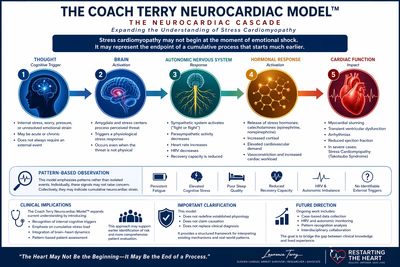
The Coach Terry Neurocardiac Model™ (Neurocardiac Cascade) organizes these processes into a continuous sequence:
Thought → Brain Activation → Autonomic Nervous System → Hormonal Response → Cardiac Function
This model does not introduce new biological mechanisms.
It integrates established findings into a clinically interpretable structure aligned with real-world patient presentation.
MECHANISTIC ALIGNMENT
Brain–Heart Interaction
Research has demonstrated that increased activity in the amygdala—a key stress-processing region—correlates with higher cardiovascular risk (Tawakol et al., 2017).
Autonomic Nervous System
Imbalance between sympathetic and parasympathetic systems has been strongly associated with arrhythmias and cardiac instability (Thayer & Lane, 2007).
Catecholamine Surge
Patients with stress cardiomyopathy have been shown to exhibit catecholamine levels significantly higher than those observed in myocardial infarction (Wittstein et al., 2005).
Stress Physiology
Chronic stress has been linked to both protective and damaging physiological effects depending on duration and recovery (McEwen, 1998).
PATTERN-BASED OBSERVATION
This model emphasizes longitudinal patterns rather than isolated events.
Emerging observations suggest pre-event indicators may include:
• Persistent fatigue
• Reduced recovery capacity
• Elevated cognitive stress
• Subtle autonomic imbalance
• Lack of identifiable external triggers
Individually, these may not be clinically alarming.
Collectively, they may indicate cumulative neurocardiac strain.
CLINICAL IMPLICATIONS
The Neurocardiac Model expands current understanding by introducing:
• Recognition of internal cognitive triggers
• Emphasis on cumulative stress load
• Integration of brain–heart dynamics
• Pattern-based patient assessment
CLARIFICATION
This model:
• Does not redefine established physiology
• Does not claim causation
• Does not replace clinical diagnosis
It provides a structured framework for interpreting existing mechanisms.
FUTURE DIRECTIONS
Ongoing work includes:
• Case-based data collection
• HRV and autonomic monitoring
• Pattern recognition analysis
• Interdisciplinary collaboration
CONCLUSION
Stress cardiomyopathy may not begin at the moment of emotional shock.
It may represent the endpoint of a cumulative neurocardiac process.
Understanding that process may improve early recognition and prevention.
REFERENCES